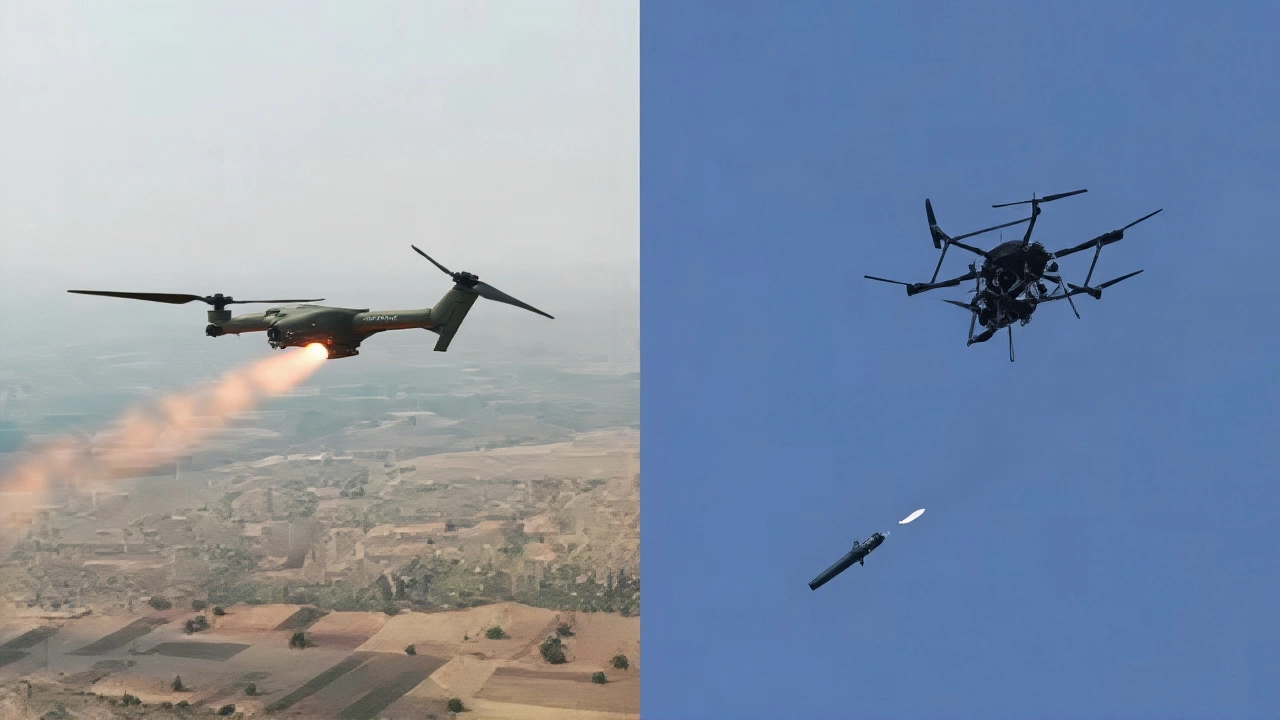
When Defence Research and Development Organisation (DRDO) successfully flew its indigenous stealth drone on July 1, 2022, it didn't just mark a technical milestone. It sent a clear signal across the border to neighbors like China and Pakistan that India’s aerial capabilities have evolved dramatically. The aircraft, widely known in media circles as Ghatak (meaning 'lethal' or 'deadly'), is no mere reconnaissance tool. It’s an armed combat platform designed to strike with precision.
The test took place at the Aeronautical Test Range in Chitradurga, Karnataka. While official details remain tight-lipped, the implications are loud. This isn’t just about flying; it’s about surviving and striking in contested airspace.
The Engineering Behind the Stealth
Here’s the thing about modern warfare: visibility is vulnerability. That’s why the design of this autonomous flying wing matters so much. Unlike traditional drones with bulky tails and visible engines, this demonstrator uses a sleek, tailless configuration that minimizes its radar cross-section. Think of it as making the aircraft nearly invisible to enemy radars.
The heart of the beast? An indigenous Kaveri engine. Yes, the same engine project that has been in development for years. In this application, it provides 52 kilonewtons of thrust. For context, that’s enough power to push a vehicle weighing less than 15 tons to high altitudes. Reports suggest the prototype can reach up to 30,000 feet. At that height, it’s above many short-range air defenses, giving it a significant tactical advantage.
But size matters too. The prototype tested was relatively compact—just 4 meters long with a 5-meter wingspan. Don’t let the small stature fool you. This platform is designed to carry missiles, bombs, and precision-guided munitions. It’s not just watching from the sidelines; it’s ready to engage.
Beyond Ghatak: The Broader Drone Ecosystem
Ghatak is impressive, but it’s part of a larger puzzle. India is rapidly building a layered unmanned aerial capability. Take the TAPAS-BH-201, another DRDO project. It’s a Medium Altitude Long Endurance (MALE) drone. Recent tests showed it reaching 28,000 feet with an endurance of 18 hours. The Indian Army is keen on procuring 97 of these units. Why? Because persistent surveillance is half the battle.
Then there’s the private sector stepping up. A Bengaluru-based startup recently unveiled the "Kaal Bhairav," a combat drone capable of 30-hour continuous flight. This shift from purely government-led projects to including agile startups signals a maturation of India’s defense industrial base. It’s a move toward self-reliance, or "Atmanirbhar Bharat," in action.
We’re also seeing concepts like the Combat Air Teaming System (CATS), developed by Hindustan Aeronautics Limited (HAL) alongside DRDO. CATS includes variants like Warrior, Hunter, Alpha, and Infinity. These aren’t just drones; they’re loyal wingmen. They can fly alongside manned fighters, taking the first hit or scouting ahead. The goal? To outpace Chinese and American drone tech.
Strategic Implications for Neighbors
So, why are China and Pakistan paying attention? Geography dictates strategy. India shares long, often disputed borders with both nations. A stealth drone like Ghatak changes the calculus. It allows for deep penetration into enemy territory without risking pilot lives. Imagine striking a missile battery or a command center with minimal warning. That’s the threat profile.
Pakistan, which has relied heavily on imported drones like the Wing Loong series, now faces a peer competitor with indigenous stealth tech. China, already a global leader in drone warfare, sees India closing the gap. This isn’t just about one aircraft; it’s about denying airspace dominance. If India can operate stealthily over the Line of Control or along the LAC, it gains critical intelligence and strike options.
The integration of AI is another layer. Future iterations will likely use artificial intelligence for target recognition and autonomous decision-making. This reduces the lag time between detection and engagement. In modern conflicts, seconds count. An AI-driven drone can react faster than a human operator thousands of kilometers away.
What’s Next for Indian Aviation?
The road ahead involves scaling up production and refining tactics. The current prototypes are demonstrators. The next step is operational induction. We expect to see more joint exercises involving these platforms. Also, watch for advancements in network-centric warfare. Drones won’t fight alone; they’ll be nodes in a larger web connecting satellites, ground troops, and fighter jets.
There’s also the concept of the "drone mothership." Imagine a large MALE UAV carrying smaller interceptor drones. It stays airborne for days, launching mini-drones to counter enemy swarms. This multi-layered approach suggests India is preparing for complex, hybrid threats. It’s a smart adaptation to how wars are fought today.
Frequently Asked Questions
What is the primary role of the Ghatak drone?
The Ghatak drone is primarily designed as an Unmanned Combat Aerial Vehicle (UCAV). Unlike surveillance-only drones, it is equipped to carry and launch precision-guided missiles and bombs. Its stealth features allow it to penetrate defended airspace undetected, making it ideal for high-risk strike missions against strategic targets.
How does Ghatak differ from the TAPAS-BH-201?
While both are indigenous, their roles differ significantly. TAPAS-BH-201 is a Medium Altitude Long Endurance (MALE) drone focused on Intelligence, Surveillance, and Reconnaissance (ISR). It prioritizes loitering time and sensor payload. Ghatak, however, is a stealth flying-wing designed for combat. It emphasizes low observability (stealth) and strike capability over long-endurance surveillance.
Is the Kaveri engine reliable for drone operations?
The Kaveri engine has faced challenges in manned fighter jet programs due to weight and complexity issues. However, for a drone, where pilot safety isn't a concern and weight constraints are different, it offers powerful thrust (52 kN). Its use in Ghatak demonstrates a practical application for the technology, leveraging its raw power for high-altitude performance without the need for life-support systems.
Who are the main competitors to India's new drone fleet?
China is the primary competitor, possessing advanced stealth drones like the GJ-11 and extensive swarm technologies. Pakistan operates various Chinese-made drones such as the Wing Loong and CH series. India's development of indigenous stealth and AI-driven systems aims to neutralize the technological edge held by these neighbors, ensuring parity in regional aerial conflicts.
When will the Ghatak drone enter active service?
Exact induction dates are not publicly disclosed. After successful prototype testing in 2022, the program typically moves through further refinement, weapons integration tests, and operational evaluation by the Indian Air Force. Given the complexity of stealth technology, full operational capability could take several more years, likely in the late 2020s.